Biscayne Bay Islands: What Miami’s Famous Islands Are Really Like
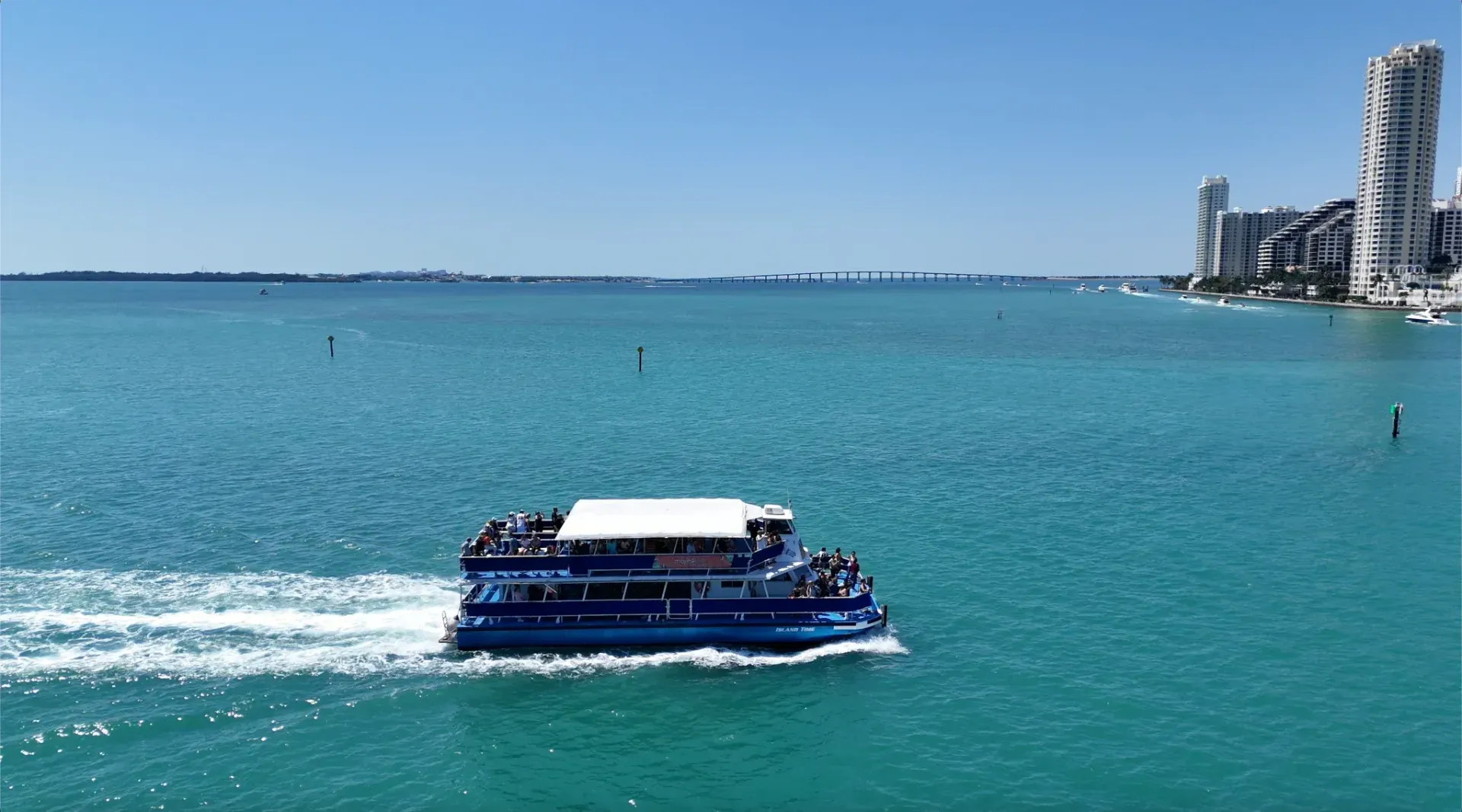
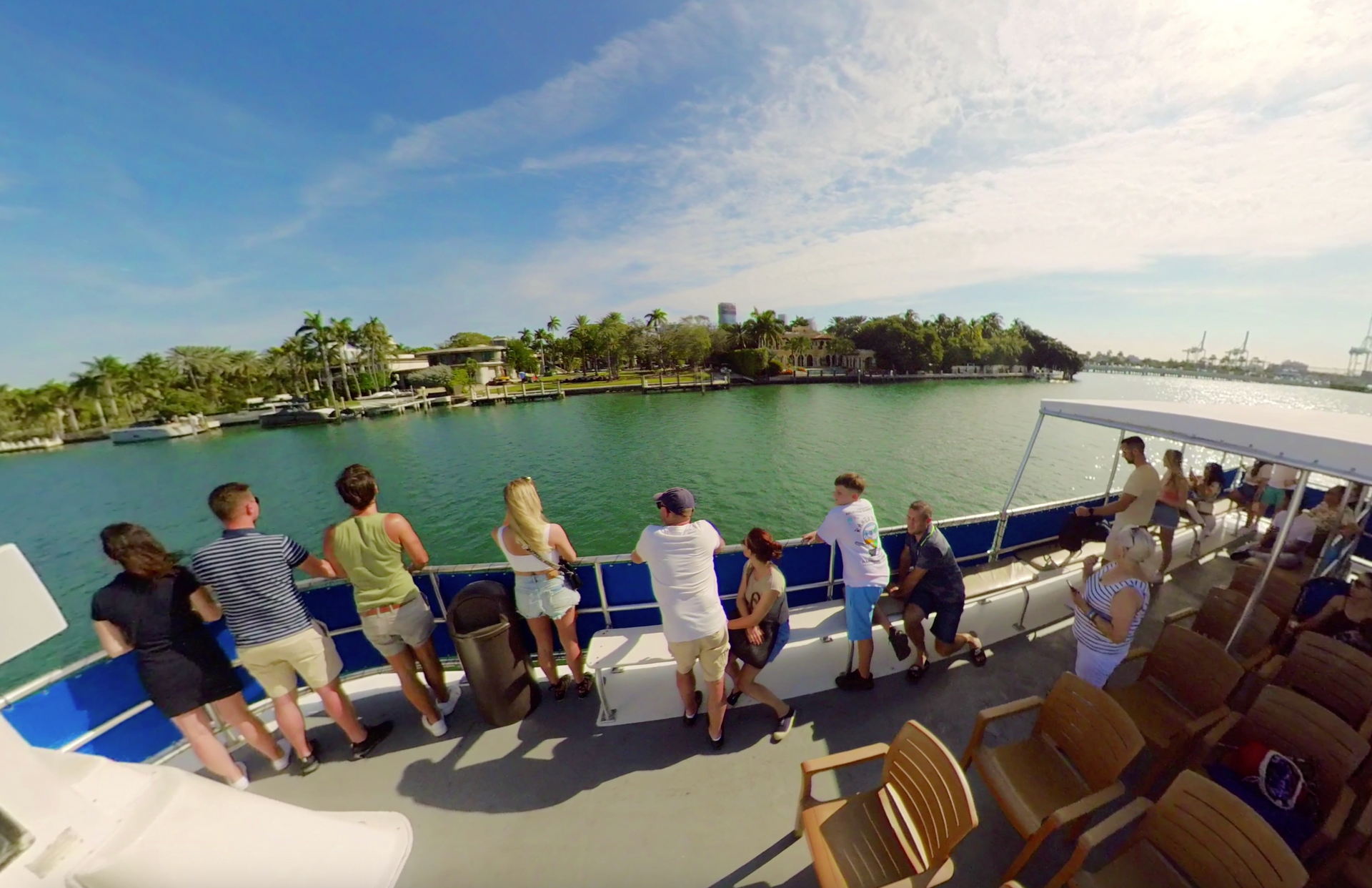
The Biscayne Bay islands are among Miami’s most recognizable landmarks, but seeing them from the water reveals a completely different side of the city. Guests often board our Miami Star Island Cruises expecting Star Island and celebrity mansions to be the main attraction. Then Miami opens up around them—waterfront architecture, historic islands, local boating life, and the Miami skyline. Star Island may be the star of the show, but it’s only one part of what makes 90 minutes on Biscayne Bay unforgettable.
What Are the Biscayne Bay Islands?
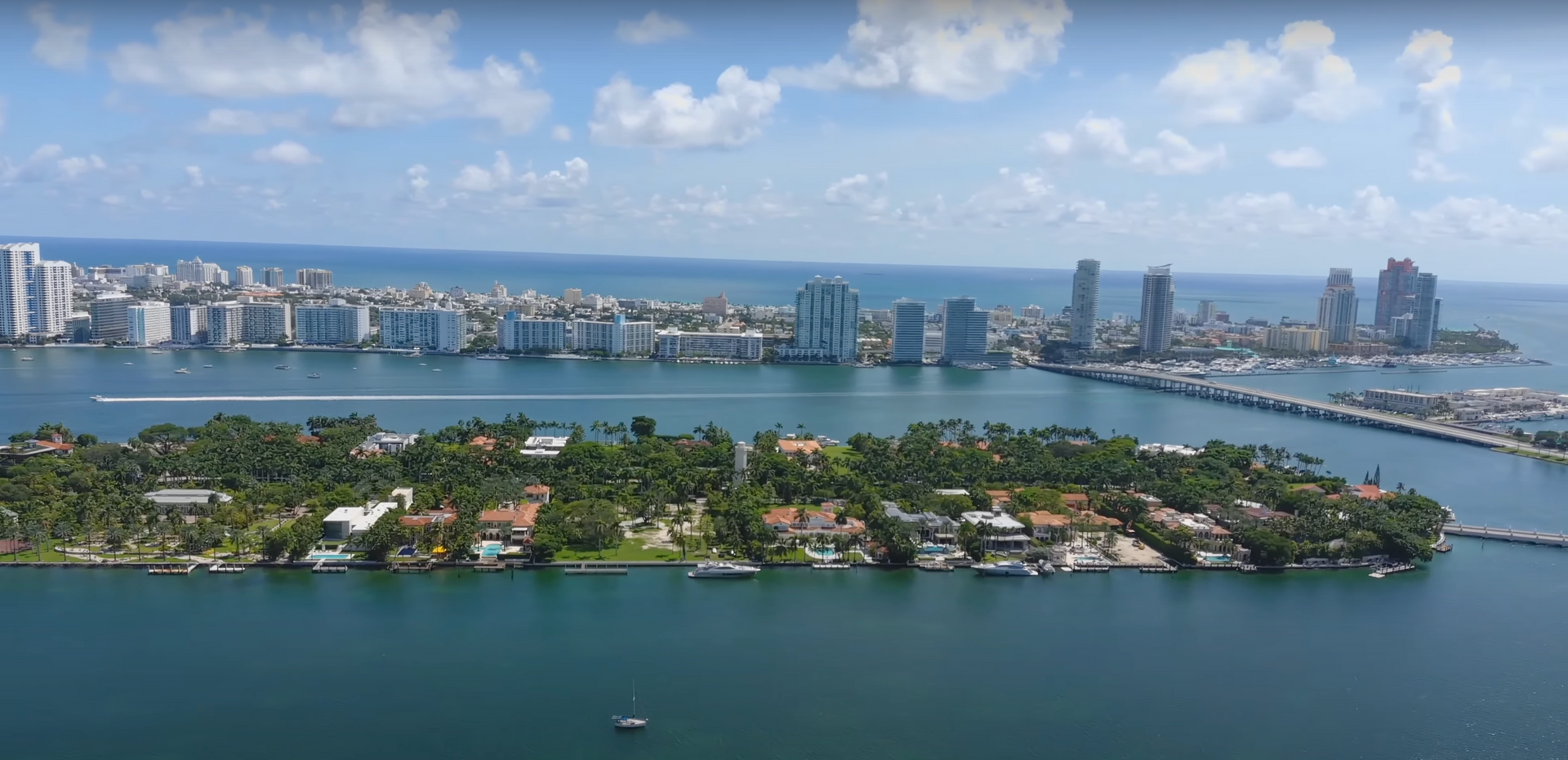
The Biscayne Bay islands are part of what makes Miami look and feel completely different from the water. Spread between Miami and Miami Beach, they include private residential islands, historic landmarks, and man-made communities shaped by more than a century of waterfront development.
On our 90-minute cruises, these are some of the islands passengers experience from the water:
- Star Island — famous for enormous waterfront estates, distinctive architecture, and a long history of high-profile residents.
- Palm Island — a private residential island where luxury homes line the waterfront near the MacArthur Causeway.
- Hibiscus Island — Palm Island’s neighboring community, also dominated by waterfront residences and private docks.
- Fisher Island — an exclusive island community beside Government Cut that looks dramatically different depending on where you are on the bay.
- Venetian Islands — a chain of man-made islands stretching across Biscayne Bay between Miami and Miami Beach.
- Monument Island — a completely different experience: an artificial island dominated by the historic Henry M. Flagler Memorial rather than private mansions.
But a map doesn't show what passengers actually experience. From the water, the islands become the foreground while Miami keeps changing behind them—waterfront architecture, boats, Miami Beach, Downtown, Brickell, and the skyline all appearing from different angles as the cruise moves through Biscayne Bay.
Star Island Miami: Big Reputation, Surprisingly Small Island
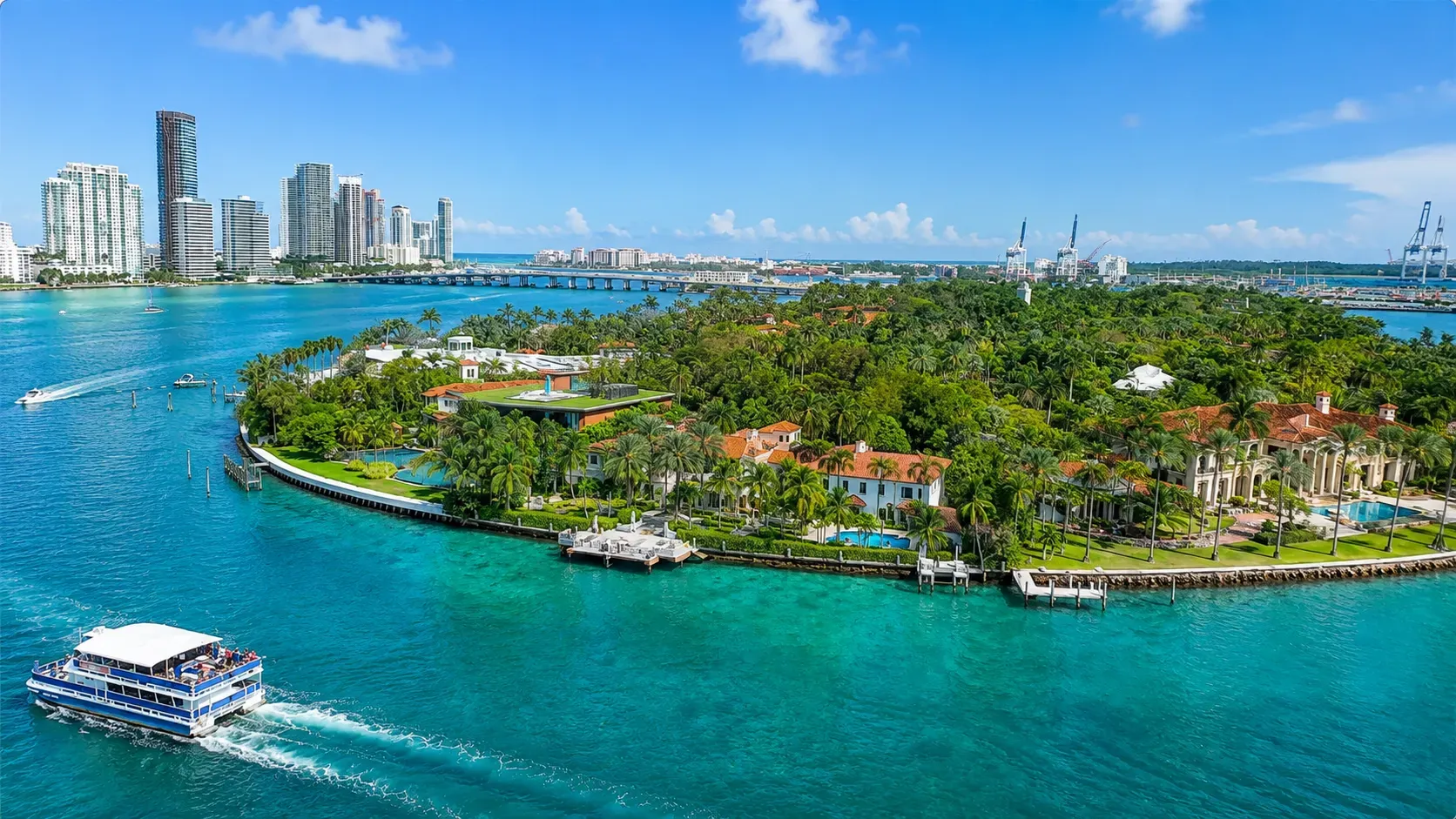
Star Island Miami is much smaller than its worldwide reputation suggests. The man-made island covers roughly 86 acres and has only about 30 homes today. Yet from Biscayne Bay, the scale of individual properties can make the island feel much larger than it actually is.
That contrast is one of the first things we notice with passengers: the island is compact, but some of the estates are enormous.
What Star Island Really Looks Like From the Water
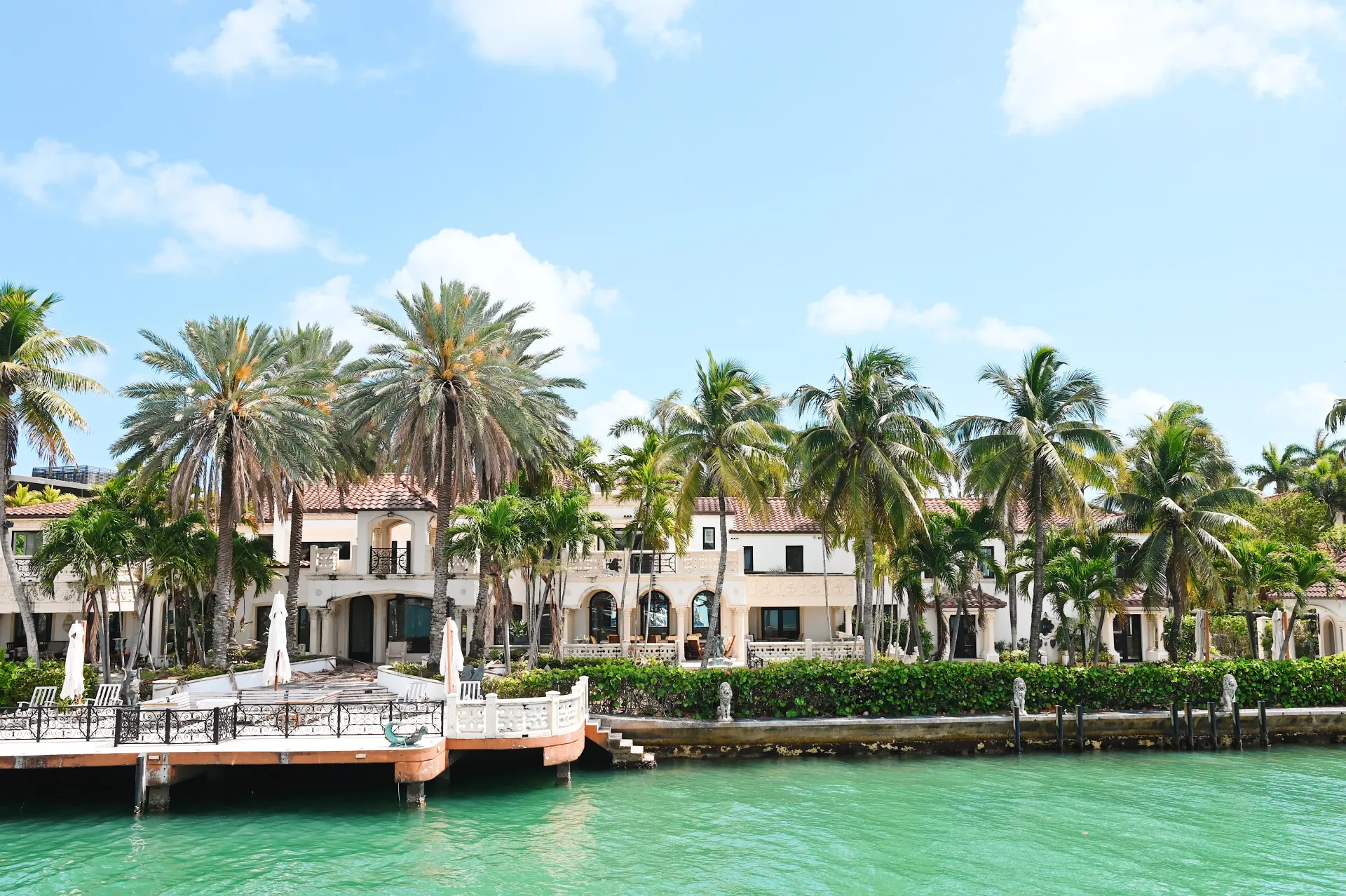
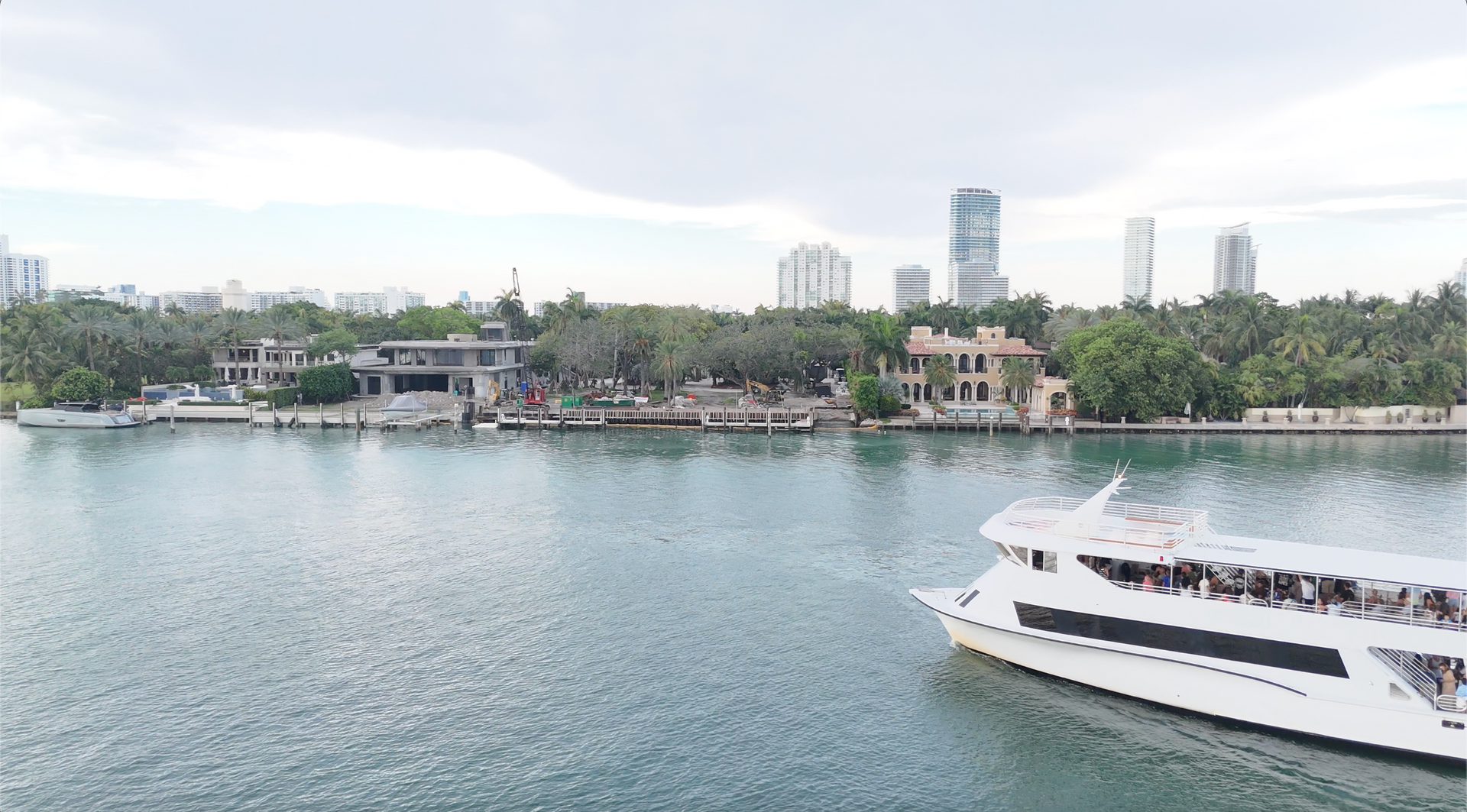
From a sightseeing boat, you're seeing the side of Star Island that matters most to this article: its waterfront. Instead of simply passing the guarded entrance by road, passengers get a moving view of private docks, seawalls, landscaping, pools, and homes designed around Biscayne Bay.
A few things immediately stand out:
- No single architectural style defines the island. Neighboring estates can look completely different.
- The waterfront lots create a sense of scale that is difficult to appreciate from land.
- Private docks and boats become part of the properties, not separate from them.
- Landscaping is a major part of the view, sometimes obscuring portions of the homes entirely.
- The island looks lived-in. Gardeners, maintenance crews, pool workers, and other everyday activity are often more realistic sights than a celebrity standing outside.
And that's where the reality of Star Island becomes more interesting than the mythology.
Who Actually Lives on Star Island?
This is one of the questions passengers ask us most.
Some Star Island properties have well-documented ownership and histories, particularly homes associated with prominent business figures, entertainers, athletes, and other public figures. But that doesn't mean every waterfront mansion can—or should—be assigned a celebrity name.
Our approach is simple: if we can reliably identify a property, we can tell its story. If we can't, we don't invent one.
Celebrity sightings aren't guaranteed either. In reality, you can cruise past Star Island without seeing a single famous person.
And that's completely fine.
Because once you're actually there, Star Island stops being only about who lives behind the gates. It becomes about what they built along the water.
How Long Do You Actually See Star Island?
Here's something most articles about Star Island won't tell you.
On a typical 90-minute sightseeing cruise traveling around 6–7 knots, the Star Island portion itself may account for only about 10 to 20 minutes of the experience. Timing can change with the captain's route, currents, weather, marine traffic, and operating conditions.
That's an important distinction.
Star Island may be the name passengers recognize first, but it doesn't dominate the entire cruise.
Once the boat continues through Biscayne Bay, the perspective keeps changing—and so do the islands.
Fisher Island Miami: Where the View Starts to Change
Fisher Island Miami is where the Biscayne Bay experience begins to feel different.
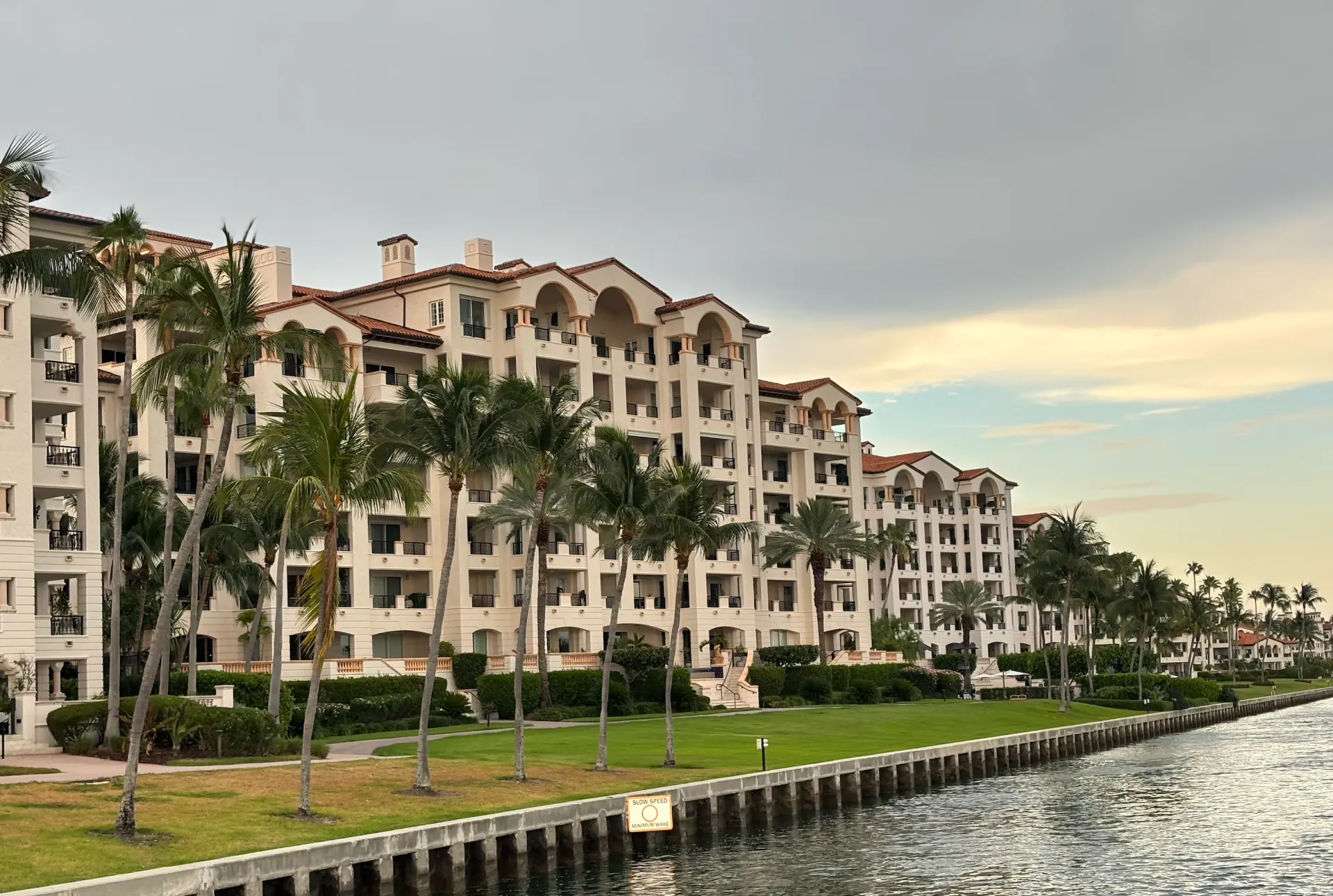
From the water, the island doesn't look like Star Island, Palm Island, or Hibiscus Island. Instead of individual waterfront mansions dominating the view, Fisher Island appears more layered—almost like an entire community rising from the edge of Biscayne Bay.
And from the right angle, passengers start noticing something unusual.
The Fisher Island “Staircase”
From certain points on Biscayne Bay, Fisher Island looks almost like it was built in steps.
Buildings appear to rise behind one another, creating what we call the “staircase” view on our cruises. That's not an official architectural term. It's simply the best way we've found to describe what passengers can actually see from the water.
Once someone points it out, it's hard not to see it.
Fisher Island Has a Different Story
The view is modern, but the island's history goes back more than a century.
Government Cut was dredged between 1905 and 1911, separating the land that became Fisher Island. In 1919, Carl Fisher's company purchased the island from Miami businessman, banker, and philanthropist Dana A. Dorsey, then expanded its landmass dramatically. Years later, Fisher famously exchanged part of the island for William Kissam Vanderbilt II's yacht.
Today, Fisher Island is a private residential community with more than 700 families representing over 45 nationalities, according to its community association.
But from our perspective on the water, Fisher Island's most important role in the cruise isn't a statistic. It's where the view changes.
Look Ahead, Not Just at the Island
As the boat passes Fisher Island and begins heading west, something happens that passengers don't always expect.
They stop looking only at the homes beside them.
They start looking ahead.
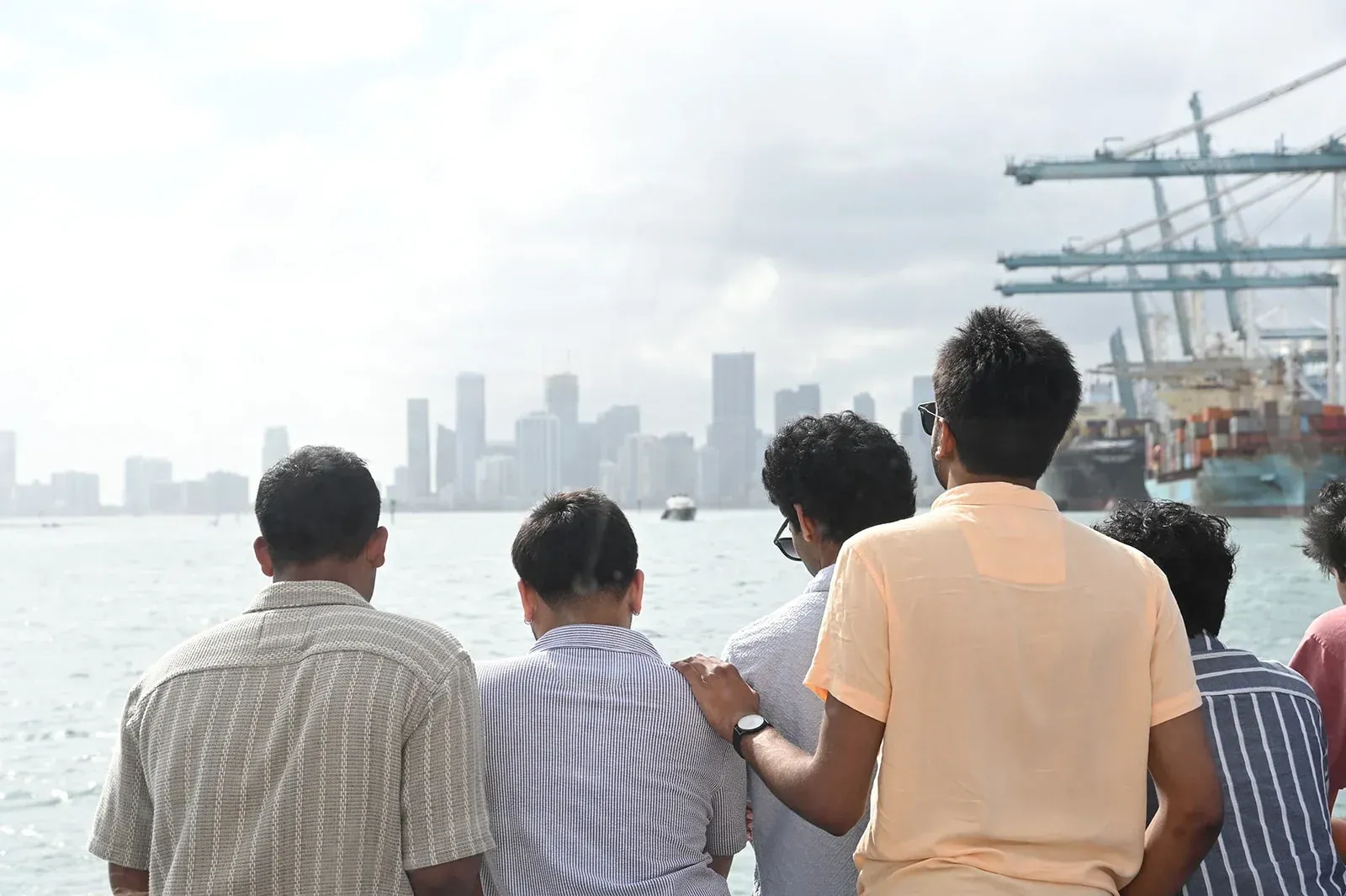
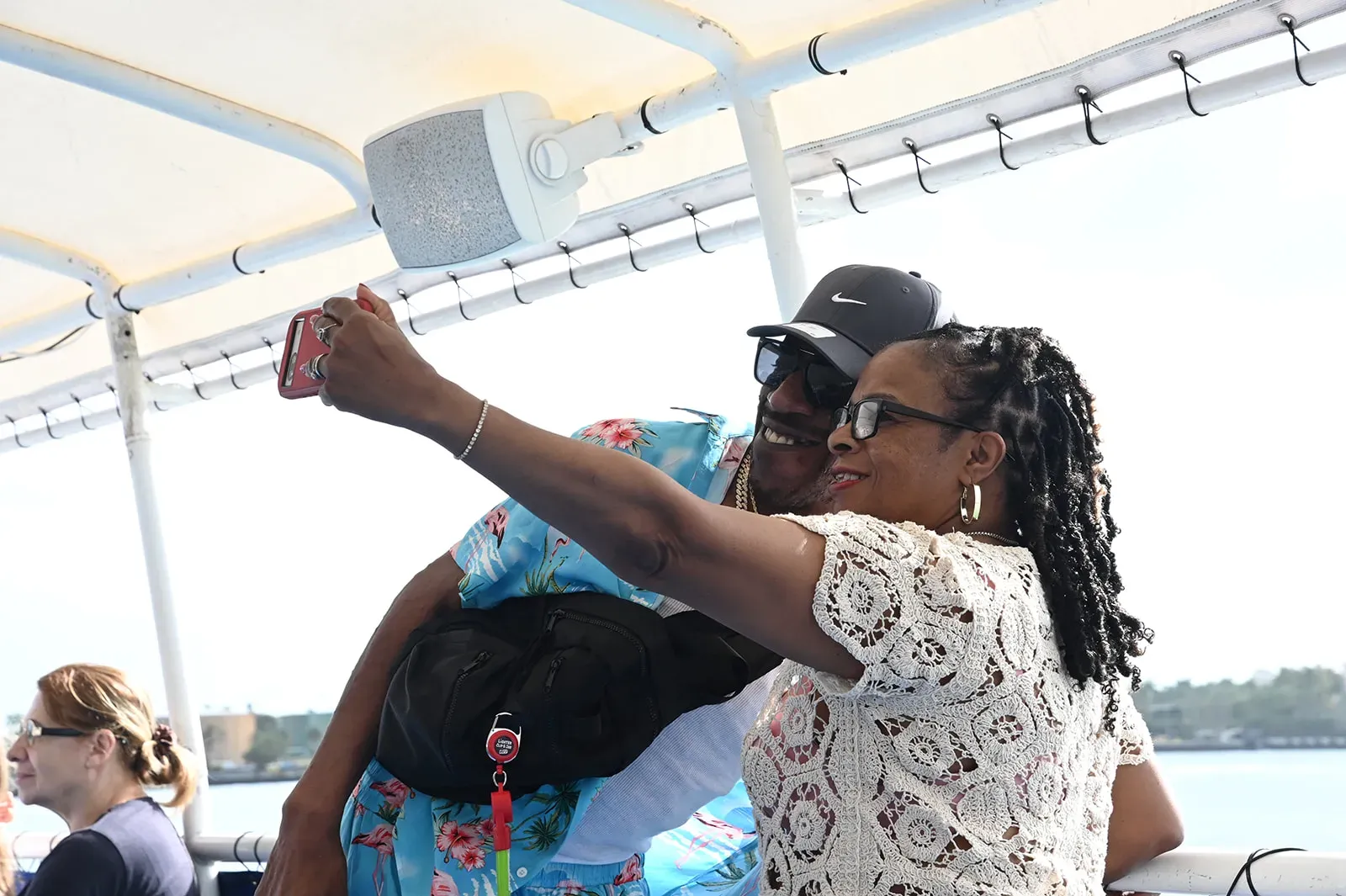
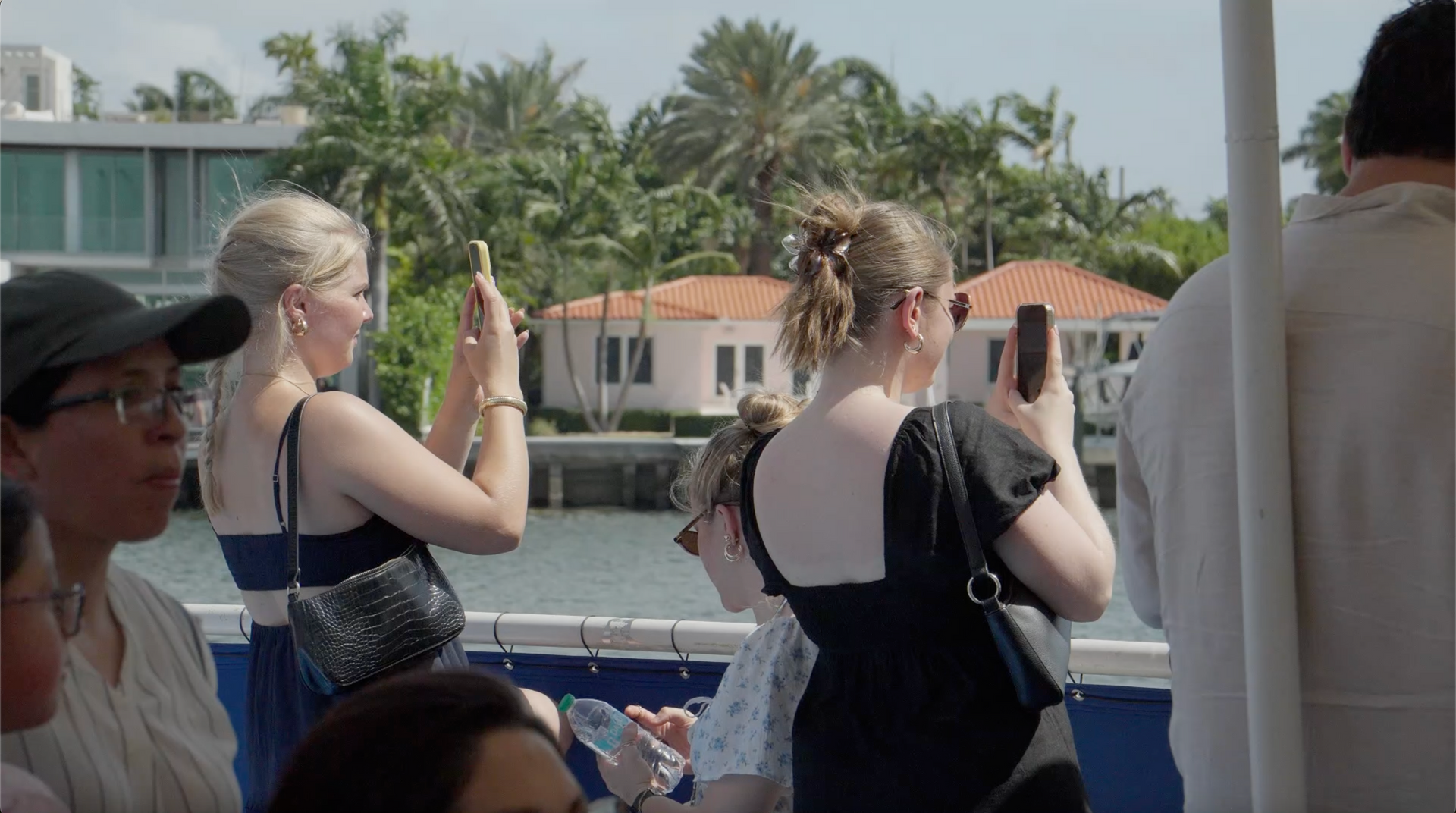
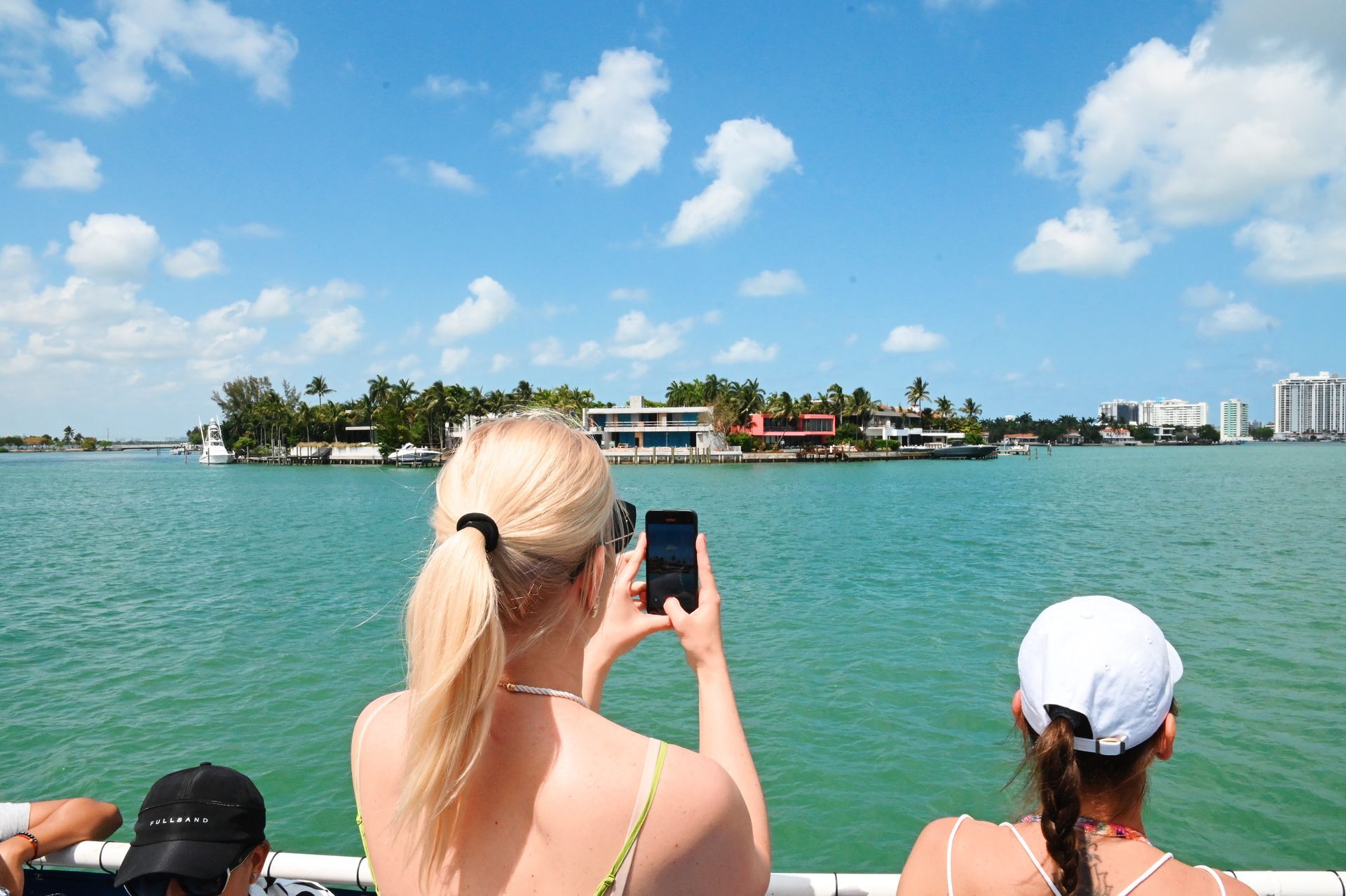
Fisher Island remains off to one side while Downtown Miami and Brickell begin opening across the water. Phones come out. Passengers move toward the best view. Someone inevitably asks a crew member to take a picture.
Star Island may have been what they expected to see.
This is the moment Miami itself becomes the attraction.
And on our cruises, we've got a name for it:
The Real Miami Moment
The Real Miami Moment
There is a point on the cruise that isn't marked on a map.
After passing Miami Beach Marina and Fisher Island, the boat begins heading west across Biscayne Bay. Fisher Island falls to the side, open water stretches ahead, and the Downtown Miami and Brickell skylines begin coming together in front of you. Downtown and Brickell both rise directly along Biscayne Bay, making the water an essential part of this view.
We call it The Real Miami Moment.
When Miami Becomes the Attraction
Up until this point, passengers have been looking for something specific: an island, a mansion, a yacht, a famous address.
Then the perspective changes.
- Biscayne Bay opens in front of you.
- Fisher Island becomes part of the foreground.
- Downtown Miami and Brickell rise across the water.
- The islands, architecture, water, and skyline finally appear together.
That's usually when the phones come out.
But the photograph isn't really the point.
The perspective is.
From the water, you begin to understand that Miami isn't a collection of separate attractions. The islands, waterfront homes, bridges, marinas, towers, and Biscayne Bay are all part of the same landscape.
The View Belongs to Everyone
People may board wanting to see how celebrities live.
Then, for a few minutes, that stops mattering.
Nobody on the boat needs to own a waterfront mansion. Nobody needs to live on Fisher Island. Nobody needs a penthouse overlooking Biscayne Bay.
Everybody gets the same skyline. Everybody gets the same water. Everybody gets the same Miami.
That's why we call it The Real Miami Moment.
And once you've seen Miami this way, the Biscayne Bay islands start making a lot more sense.
Monument Island: The Landmark That Changes the View
After cruising past residential islands, Monument Island immediately feels different.
There are no waterfront estates to identify and no famous addresses to point out. Instead, your eyes go up—to a 97-foot obelisk rising from a small artificial island in Biscayne Bay between the MacArthur and Venetian Causeways.
For passengers who boarded expecting houses and celebrity stories, it's one of the route's genuine curveballs.
Why Is There a Monument in the Middle of Biscayne Bay?
The Flagler Memorial was built in 1921 by Carl Fisher to honor Henry M. Flagler, whose Florida East Coast Railway reached Miami in 1896 and later Key West in 1912, helping accelerate South Florida's development.
Around the obelisk stand four 18-foot figures representing:
- Education
- Industry
- Prosperity
- Flagler's pioneering spirit
Even the details tell a story. The figure representing Industry holds a model of the Florida East Coast Railway and Key West Viaduct.
So when someone on the boat asks, “What the hell is that?”, there's actually a serious answer.
They're looking at a monument to part of the infrastructure and ambition that helped shape modern Miami.
Monument Island Is Still Part of Miami Life
Here's what makes Monument Island more interesting than a monument you simply drive past:
people still use the island.
The City of Miami Beach allows access by boat, and city records describe Monument Island as a popular destination for boaters. Its beaches and surrounding water have made it part of Biscayne Bay's recreational culture as well as its history.
That creates one of the most unusual contrasts among the Biscayne Bay islands.
A nearly century-old memorial stands above the water while modern Miami boating life happens around it.
The history isn't behind glass. It's sitting right in the middle of the bay.
Venetian Islands: Why the Biscayne Bay Islands Keep Attracting Miami’s Wealthiest Buyers
The Venetian Islands were created more than a century ago around an idea Miami still sells better than almost anywhere else:
Live on the water.
Today, that idea is worth millions.
But to understand why these islands remain some of Miami's most desirable addresses, you have to go back to a time when much of what you're looking at didn't even exist yet.
Miami Built Islands in the Middle of Biscayne Bay
During Miami's development boom of the early 20th century, developers weren't satisfied with the waterfront they already had.
They created more of it.
Land was dredged and filled inside Biscayne Bay, eventually producing the chain of residential islands we know today as the Venetian Islands. The causeway project that connected them was completed in 1926 during the Florida land boom.
Traveling from mainland Miami toward Miami Beach, the six principal Venetian Islands are:
- Biscayne Island
- San Marco Island
- San Marino Island
- Di Lido Island
- Rivo Alto Island
- Belle Isle
Together, they created something that would become fundamental to Miami real estate:
more waterfront.
The developers weren't simply creating neighborhoods.
They were manufacturing one of Miami's most valuable commodities — land surrounded by Biscayne Bay.
The Venetian Causeway Is Almost 100 Years Old
The road connecting these islands is nearly as interesting as the islands themselves.
Before the Venetian Causeway, there was the Collins Bridge, a massive wooden bridge completed in 1913 that connected mainland Miami with the developing Miami Beach.
That original bridge was eventually replaced along essentially the same route by what became the Venetian Causeway. Venetian Way opened to traffic on February 28, 1926.
Today, the historic Venetian Causeway consists of 12 bridges — 10 fixed bridges and two movable bridges — stretching across Biscayne Bay and connecting Miami with Miami Beach.
And here's the historical distinction worth remembering:
The Venetian Causeway is the oldest causeway in metropolitan Miami-Dade County.
It has survived hurricanes, saltwater, almost a century of Miami weather, repeated repairs, and enormous changes on both sides of Biscayne Bay.
It is now deteriorated enough that Miami-Dade is advancing a major project to replace 11 of its bridges while preserving the historic character of the corridor.
So when you see those low bridges crossing between the islands, you're not just looking at neighborhood infrastructure.
You're looking at a surviving piece of the Miami that existed before the skyline.
Miami's Melting Pot Is Getting Richer
Fast-forward a century and the Venetian Islands tell another Miami story.
Miami has always been a melting pot.
Latin America. The Caribbean. Europe. The Northeast. People have arrived here with different languages, cultures, businesses, and ambitions.
Now something else is arriving in extraordinary numbers:
wealth.
Between 2014 and 2024, Miami's millionaire population increased 94% to nearly 39,000 people.
Florida's tax structure is part of the attraction. The state has no individual state income tax, while climate, business opportunities and the South Florida lifestyle provide additional reasons wealthy people relocate here.
Miami used to be described primarily as a cultural melting pot.
Increasingly, it's becoming a melting pot of fortunes too.
But Somebody Has to Pay for the Wealth Boom
There's another side of that story.
Miami has enough personality for everybody.
Affordable Miami real estate is another question.
The arrival of higher-income residents and enormous amounts of outside capital has contributed to pressure on an already difficult housing market. In 2026, reporting showed Miami becoming wealthier even while losing residents, with roughly half of Miami-Dade households considered cost-burdened.
The people moving in and the people moving out increasingly aren't economically similar either.
Recent Miami-Dade data showed incoming residents earning an average of approximately $178,000, compared with about $89,000 among those leaving.
That's a remarkable change.
Miami isn't running out of people who want to live here. It's becoming harder for ordinary people to compete with the money arriving here.
And waterfront neighborhoods like the Venetian Islands put that transformation directly in front of you.
A Star Island Sightseeing Cruise Shows You What the Money Is Buying
This is where sightseeing cruises around Star Island Miami become more interesting than simply pointing at expensive houses.
People board expecting celebrity mansions.
What they're actually seeing is the lifestyle behind Miami's wealth boom.
Not from a real-estate listing.
From Biscayne Bay itself.
They see islands created specifically for waterfront living. Private docks behind homes. Boats tied directly outside residences. Historic bridges connecting neighborhoods surrounded by water.
Most passengers are simply visiting Miami.
Some may fall in love with it.
Some may eventually move here.
And some may have enough money to buy exactly what they're looking at.
We're not going to claim sightseeing cruises are convincing millionaires to relocate to Miami. There's no evidence for that.
But they absolutely do something powerful:
They put Miami's waterfront lifestyle directly in front of people from around the world.
No sales presentation necessary.
Miami does that part itself.
The Venetian Islands Prove the Idea Never Changed
That's what makes the Venetian Islands so fascinating.
Nearly a century ago, developers looked across Biscayne Bay and realized people would pay more to live beside the water.
So they created islands.
They built bridges.
They connected Miami to Miami Beach.
And they sold waterfront living.
Almost 100 years later, Miami is wealthier, taller, more international, and dramatically more expensive.
The houses changed.
The architecture changed.
The boats got bigger.
The buyers got richer.
The idea never changed.
Miami continues attracting people from practically everywhere — and increasingly, enormous fortunes are arriving with them.
That creates opportunity.
It creates extraordinary real estate.
It also creates very real pressure for the people who already call Miami home.
But whether someone arrived from New York, California, Latin America, Europe, or somewhere else entirely, the thing people were willing to pay a premium for in the 1920s remains one of Miami's most valuable assets today:
Biscayne Bay.
Are the Biscayne Bay Islands Natural or Man-Made?
One of the biggest misconceptions about the Biscayne Bay islands is that they have all been sitting here naturally for thousands of years.
They haven't.
Some islands and keys in Biscayne Bay are natural. Others were expanded or altered by human activity. And several of the islands people immediately associate with Miami today were literally created from the bottom of the bay.
Miami Didn't Just Develop the Waterfront. It Created More of It.
During Miami's early development boom, dredging became a way to turn open water into extremely valuable real estate.
Star Island was among the early artificial residential islands created in Biscayne Bay. Palm Island and Hibiscus Island followed, along with the man-made islands associated with the Venetian Causeway.
By the middle of the 1920s, the geography of northern Biscayne Bay was already beginning to look dramatically different from what had existed only a decade earlier.
Think about that for a second.
Some of the waterfront neighborhoods people now associate with Miami luxury, architecture, yachts, and multimillion-dollar real estate started as open water.
People didn't simply build houses beside Biscayne Bay.
They built new land inside it.
Not Every Biscayne Bay Island Has the Same Story
But this is where the term Biscayne Bay islands gets much bigger than Star Island and Miami Beach.
The bay contains natural islands and keys, artificial residential islands, dredge-spoil islands, and protected habitats.
That's why two islands sitting in the same bay can have completely different histories.
One may have formed naturally.
Another may have been created to sell waterfront lots.
Another may have formed from material removed while dredging navigation channels.
And then Miami did something even stranger.
It turned some of them pink.
When the Biscayne Bay Islands Turned Pink
In May 1983, artists Christo and Jeanne-Claude transformed 11 man-made islands in Biscayne Bay into one enormous work of environmental art.
The project was called Surrounded Islands.
Approximately 6.5 million square feet of bright pink woven polypropylene fabric surrounded the islands, extending roughly 200 feet over the water from their shorelines.
For just under two weeks, Biscayne Bay became part of the artwork itself. The pink fabric contrasted against the blue water, green vegetation, and Miami sky, creating one of the most recognizable images in the bay's modern history.
This wasn't some little Miami art experiment.
The project took approximately 30 months, $3.1 million, 10 permits, seven public hearings, four court appearances, and hundreds of workers to make happen.
Crews also removed roughly 40 tons of debris from the islands while preparing the installation.
And when those islands finally turned pink, people wanted to see them.
From everywhere.
People Were Taking Biscayne Bay Sightseeing Cruises to See Them
This is where the history becomes almost perfect for the story we're telling today.
Contemporary reporting from May 1983 described Miami residents and tourists planning to experience Surrounded Islands from land, air, and water.
One sightseeing package offered visitors a flight over the installation, a bus ride across nearby causeways, and something that sounds remarkably familiar:
A 90-minute boat tour through Biscayne Bay.
Yes.
A 90-minute Biscayne Bay sightseeing cruise. In 1983.
The attraction wasn't Star Island mansions.
It wasn't celebrity houses.
It wasn't the modern Miami skyline.
It was the islands themselves.
More than four decades later, the boats are different and Miami's skyline is almost unrecognizable.
But people are still getting on sightseeing boats for essentially the same reason:
There are parts of the Biscayne Bay islands you simply understand better from the water.
Biscayne Bay Is Where Miami Goes to Play
The Biscayne Bay islands may look peaceful from a distance.
Come back on a beautiful Saturday afternoon.
It's a completely different bay.
Yachts are anchored. Jet Skis cut across the water. Fishing boats head toward the ocean. Sailboats move between the islands. Music carries across the water. Families and friends spend hours aboard boats with absolutely nowhere they need to be.
This isn't the Miami you experience from a sidewalk.
This is Miami on the water.
What Biscayne Bay Really Looks Like on a Weekend
There's no single version of Biscayne Bay.
Some mornings, the water can feel surprisingly quiet.
Then the weekend arrives.
Depending on the weather, location, and marine conditions, you may see:
- Jet Skis running across open sections of the bay
- Yachts anchored near islands and popular boating areas
- Fishing boats heading through Government Cut toward the Atlantic
- Sailboats crossing between Miami and Miami Beach
- Paddleboards and smaller recreational watercraft closer to shore
- Sightseeing cruises moving between the islands
- Working vessels and commercial traffic sharing the same waterways
- Groups spending practically the entire day aboard their boats
And that's when you realize something:
Biscayne Bay isn't Miami's backyard. It's one of its busiest neighborhoods.
The streets just happen to be made of water.
Out Here, Boats Replace Cars
Living around Biscayne Bay changes the way people use the city.
A private dock isn't simply something beautiful behind a waterfront house.
It's an entrance.
Channels become routes.
Marinas become parking lots.
Bridges sometimes have to open because the traffic underneath them matters too.
Government Cut connects Biscayne Bay with the Atlantic Ocean and serves as the principal entrance channel to the Port of Miami, putting recreational boating, sightseeing vessels, cruise ships, and commercial marine traffic remarkably close to one another.
That's something a map doesn't communicate particularly well.
From a boat, you watch the system working.
The Islands Are Part of Something Bigger
This is also why looking at the Biscayne Bay islands only as expensive real estate misses half the story.
Yes, there are extraordinary houses.
Yes, there are private islands and multimillion-dollar properties.
But the water surrounding them isn't decorative.
It's being used constantly.
People work here.
People fish here.
People commute here.
People celebrate birthdays here.
People spend Sundays here.
People teach their kids how to boat here.
And generations of Miami families have built memories around this water without ever owning one of the mansions sitting beside it.
You don't need a Star Island address to belong on Biscayne Bay.
Miami Doesn't End at the Shoreline
That's probably the biggest difference between seeing Miami from land and experiencing it from the water.
From land, Biscayne Bay can look like the beautiful blue space separating Miami from Miami Beach.
Once you're in the middle of it, you realize the opposite is true.
The bay doesn't separate Miami. It connects it.
It connects neighborhoods.
It connects islands.
It connects Miami to Miami Beach and the Atlantic beyond it.
And it connects two very different versions of the city: the Miami people build on land and the Miami people experience on the water.
That's why the Biscayne Bay islands make more sense once you're actually out here.
They're not little pieces of land floating outside the city.
They're sitting right in the middle of how Miami lives.
What Is the Best Time to See the Biscayne Bay Islands?
People ask us this all the time:
“What's the best time to see the Biscayne Bay islands?”
And after spending years operating sightseeing cruises on Biscayne Bay, our answer is pretty simple:
There isn't one.
Miami doesn't give you the same experience at 10:30 in the morning that it gives you at 4:00 in the afternoon, sunset, or after dark.
That's actually part of what makes the bay interesting.
Morning: When You Actually Want to See Everything
If your main goal is seeing the islands, houses, architecture, boats, and all the little details along the waterfront, morning is hard to beat.
You're cruising in full daylight, the day is just getting started, and there's usually less recreational boat traffic than you'll see later on a busy weekend.
It's not about being the most dramatic departure.
It's about being able to look around and actually see Miami.
Afternoon: This Is When the Bay Wakes Up
As the day moves along, Biscayne Bay starts getting busier.
More boats come out. More Jet Skis hit the water. Marinas get active. On weekends, especially when Miami gives us beautiful weather, you can feel the difference.
If morning shows you the islands, afternoon starts showing you the lifestyle around them.
This is when you realize Biscayne Bay isn't sitting there looking pretty for tourists.
Miami is actually using it.
Sunset: Miami Starts Changing in Front of You
This is probably the time people ask us about the most.
And we understand why.
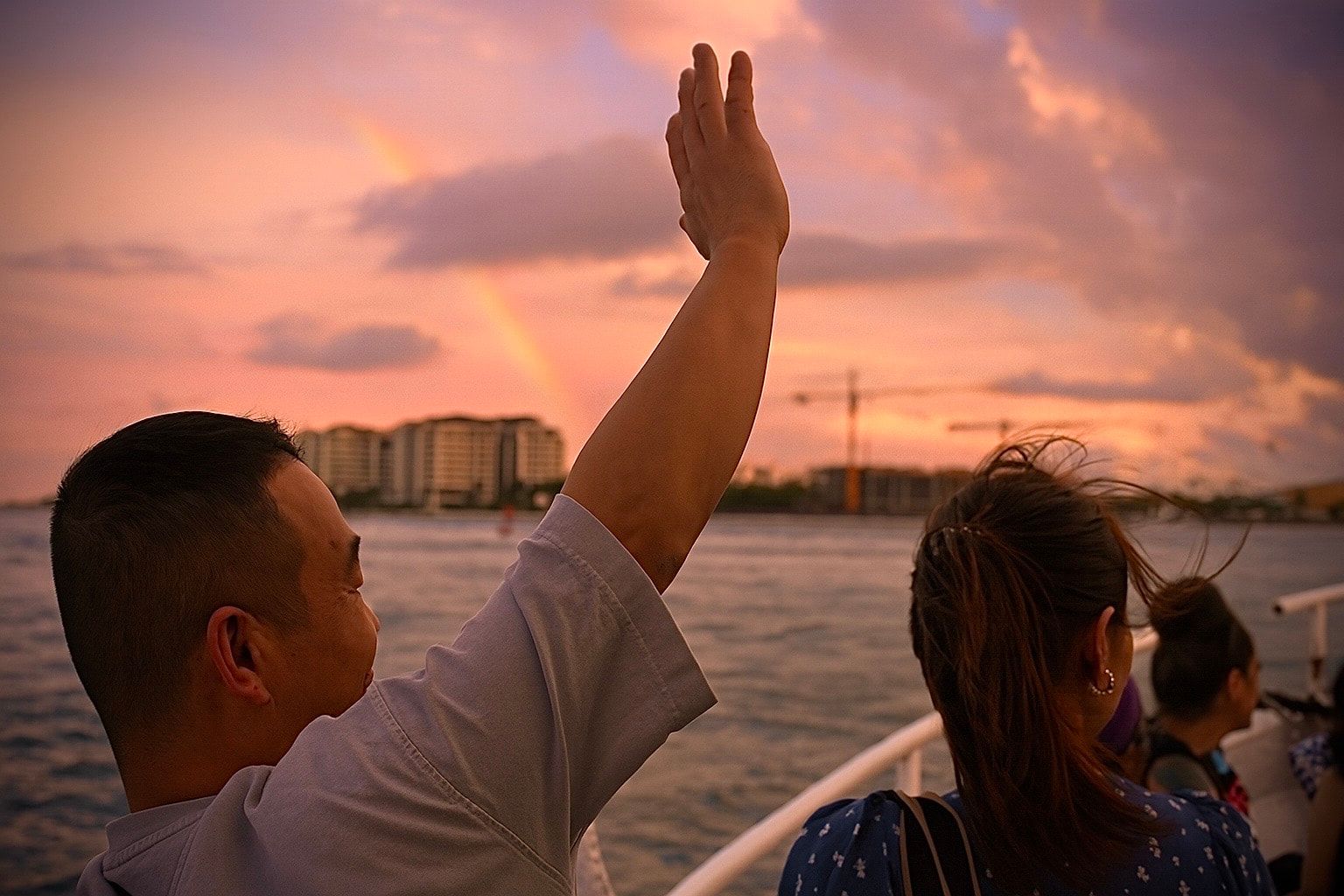
A Miami Sunset Cruise can give you several completely different views during the same 90-minute trip.
You may leave in full daylight.
Then the light gets warmer.
The sun starts dropping.
The buildings begin reflecting different colors.
And depending on the departure time and time of year, you may start seeing the city lights before you return.
But we're also going to tell you something other websites might conveniently leave out:
Nobody controls a Miami sunset.
We can't order you an orange sky.
Miami weather changes quickly. Clouds move in. Rain happens. Sometimes the sunset is incredible. Sometimes Mother Nature has other plans.
That's Miami.
But when everything lines up?
Biscayne Bay at sunset is hard to beat.
Night: Now You're Looking at a Different Miami
A Miami Night Cruise isn't just a daytime sightseeing cruise with less sunlight.
It feels completely different.
Some of the details you were studying during the day fade into the darkness.
Then something else takes over.
House lights reflect across the water. Bridges glow. Boats move through the darkness. Downtown Miami and Brickell light up across Biscayne Bay.
During the day, your eyes naturally go toward the islands and waterfront properties.
At night, Miami itself starts stealing the show.
So Which One Would We Choose?
That's the question everybody wants us to answer.
- Morning?
- Afternoon?
- Sunset?
- Night?
After operating these cruises day after day, we still wouldn't tell you there's one perfect time.
If you want maximum daylight and details, go earlier.
If you want to see Biscayne Bay active, go in the afternoon.
If you're chasing golden hour, take the sunset cruise.
If you want Miami illuminated across the water, go at night.
But here's what we wouldn't do:
We wouldn't spend half our vacation trying to predict the perfect 90 minutes in Miami.
Pick the experience you want.
Get on the water.
And let Miami handle the rest.
Why Miami Makes More Sense From the Water
There is a version of Miami you can understand from the street.
Then there is the Miami you understand once you're in the middle of Biscayne Bay.
During a 90-minute cruise through the Biscayne Bay islands, you're not simply passing beautiful homes, bridges, and skylines.
You're moving through more than a century of decisions that turned Miami into Miami.
And almost all of them come back to the water.
Before the Skyline, There Was the Bay
Long before Brickell was covered in glass towers and Star Island was lined with multimillion-dollar estates, Biscayne Bay was already defining this part of South Florida.
Then modern Miami began arriving fast.
Henry Flagler's Florida East Coast Railway reached Miami in 1896, the same year the city was incorporated.
Development accelerated.
Miami Beach grew across the bay.
Developers created artificial islands.
Causeways crossed the water.
Channels were dredged.
New neighborhoods appeared where there had once been nothing but Biscayne Bay.
Miami didn't just build beside the water. At times, Miami literally rebuilt the map.
You Can Still See the Decisions That Built Miami
That's what makes seeing this city from a boat different.
The history isn't somewhere behind you.
It's still sitting in the water.
Star Island shows what happened when developers realized artificial islands could become extraordinary residential real estate.
The Venetian Islands show how Miami created waterfront neighborhoods while connecting the mainland with Miami Beach.
Monument Island preserves a memorial to Henry Flagler built by Carl Fisher.
Government Cut shows how Miami opened Biscayne Bay directly to the Atlantic.
PortMiami shows what that access eventually became.
And then Downtown Miami and Brickell show you what happened when a small subtropical city became an international one.
You don't have to imagine the transformation.
It's all in the same view.
From the Street, Miami Feels Separated
This is probably the biggest thing the water changes.
Drive around Miami and everything feels like its own destination.
Star Island is behind a gate.
Fisher Island is accessible only by ferry, yacht, or other authorized water transportation.
Miami Beach feels separate from Downtown.
The Venetian Islands feel like residential neighborhoods.
PortMiami feels like another world entirely.
Then you get into Biscayne Bay.
Suddenly, the pieces come together.
You can have Fisher Island beside you, Miami Beach behind you, PortMiami in another direction, and Downtown Miami and Brickell rising ahead.
The water isn't separating all these places.
It's connecting them.
Every Generation Left Something Behind
That's what we find most interesting about the Biscayne Bay islands.
Every generation seems to have looked at this water and imagined something different.
One generation saw transportation.
Another saw land that could be created.
Another saw waterfront neighborhoods.
Another saw a place for art.
Another saw luxury real estate.
Another saw tourism.
Another saw one of the best places in America to build a skyline.
And today's Miami sees all of those things at the same time.
That's why Biscayne Bay can have a fishing boat, a sightseeing cruise, a Jet Ski, a billionaire's yacht, a cargo ship, and a cruise ship moving through the same broader landscape.
Everybody is using the same water for a completely different version of Miami.
The Skyline Changed. The Bay Stayed.
Look at Miami photographs from a century ago and you may barely recognize the city.
The skyline changed.
The neighborhoods changed.
The architecture changed.
The boats changed.
The people came from more places.
The money got bigger.
Even parts of the shoreline and the Biscayne Bay islands themselves were changed by human hands.
But the reason people kept building here never disappeared.
The water.
That's the part of Miami you understand differently once you're actually sitting in the middle of it.
The mansions make more sense.
The islands make more sense.
The bridges make more sense.
The skyline makes more sense.
Miami didn't grow around Biscayne Bay and eventually discover its value.
Biscayne Bay helped make Miami possible.
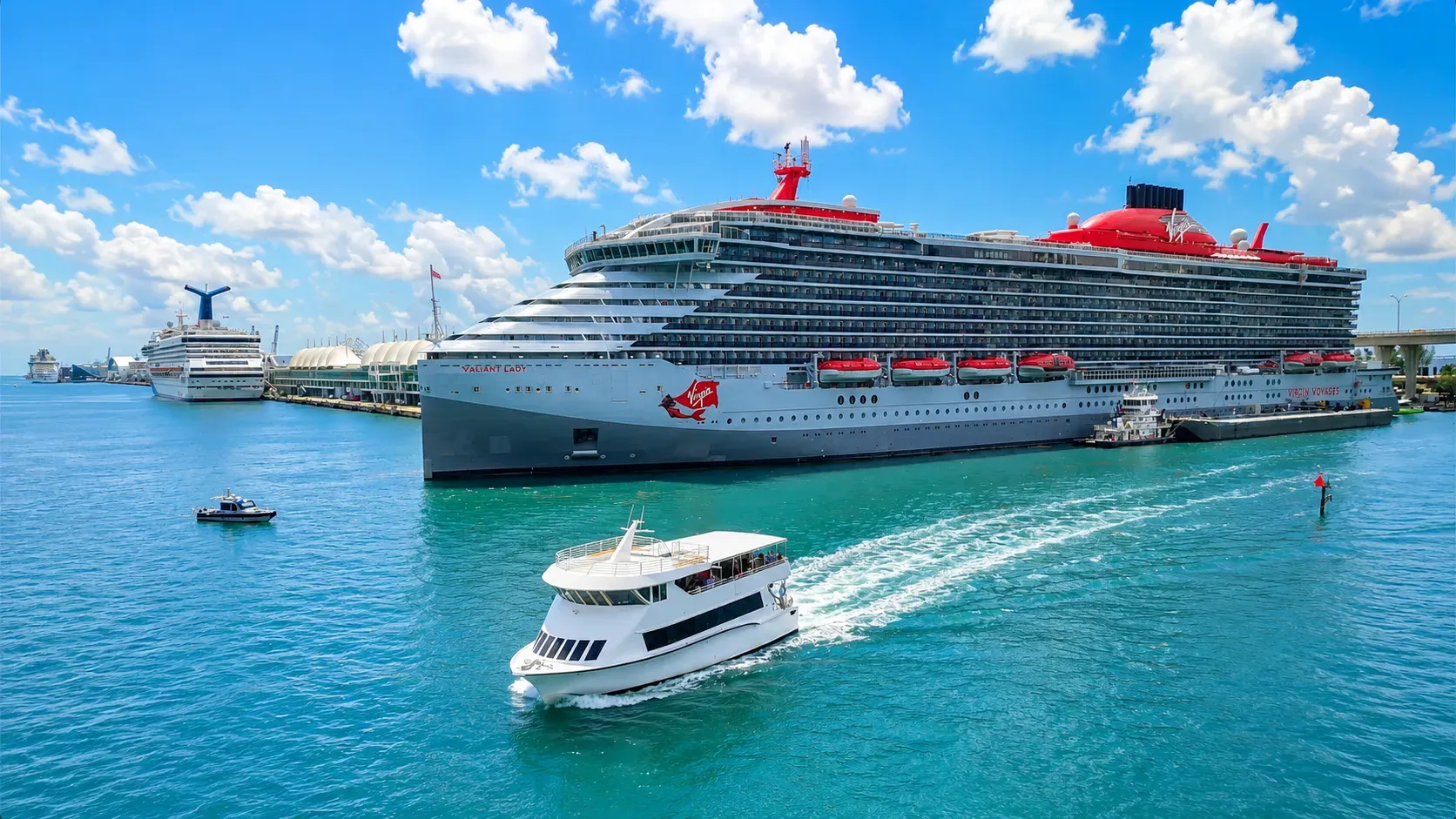
People Come for Star Island. They Discover Biscayne Bay.
People don't usually book a sightseeing cruise because they're fascinated by the geography of Biscayne Bay.
They book because they've heard about Star Island Miami.
They want to see the mansions.
They want to know who lives there.
They want to see the Miami they've seen in movies, on television, and across social media.
We understand.
Star Island gets people's attention.
But after 90 minutes on the water, something usually changes.
Star Island Gets You Curious. Biscayne Bay Takes Over.
Star Island is only a small part of what happens once the boat leaves Bayside.
The bay keeps opening.
One island becomes another.
The mansions give way to bridges, marinas, historic landmarks, Fisher Island, PortMiami, recreational boats, and completely different angles of the city.
Eventually, you're not waiting for the guide to tell you which celebrity owns which house anymore.
You're just looking at Miami.
And that's when the cruise gets better.
Because the best part of Biscayne Bay isn't one mansion.
It isn't one island.
It isn't one billionaire.
It's everything happening together.
You Don't Need to Own Miami to Experience It
We've talked a lot about money in this article.
Millions.
Billions.
Private islands.
Yachts.
Waterfront estates most people will never own.
That's part of Miami, and pretending otherwise would be ridiculous.
But here's the beautiful part:
Biscayne Bay doesn't ask for your net worth.
You don't need a Star Island address.
You don't need a Fisher Island membership.
You don't need a yacht sitting behind your house.
You don't need a $30 million waterfront property.
Get on the water and the view is still yours.
The same breeze crosses the boat.
The same sunset hits the bay.
The same skyline appears in front of everybody.
For 90 minutes, nobody owns the view.
That's What We Want You to Take Home
If you leave remembering which celebrity owns which mansion, great.
We did our job.
But if that's all you remember, then you missed the best part.
We want you to remember the island that was built from the bottom of the bay.
The monument you didn't know existed.
The history sitting underneath bridges you've probably driven across before.
The moment Fisher Island moves to the side and Miami opens in front of you.
The boats.
The architecture.
The water.
The city itself.
Because after operating sightseeing cruises on this bay and watching people experience it every day, we've learned something pretty simple:
People may come looking for somebody else's Miami.
A celebrity's house.
A billionaire's island.
A lifestyle they saw online.
But somewhere during those 90 minutes, that doesn't matter quite as much anymore.
You're here.
You're on Biscayne Bay.
And for that moment, this is your Miami too.
That's why people come for Star Island.
And discover Biscayne Bay.
Frequently Asked Questions About the Biscayne Bay Islands
What are the main islands in Biscayne Bay?
The best-known Biscayne Bay islands near Miami include Star Island, Palm Island, Hibiscus Island, Fisher Island, the Venetian Islands, and Monument Island.
Can you visit the Biscayne Bay islands?
Yes, you can experience many of Miami's Biscayne Bay islands by boat, including Star Island, Palm Island, Hibiscus Island, Fisher Island, the Venetian Islands, and Monument Island.
Is Star Island Miami man-made?
Yes, Star Island Miami is a man-made island created in Biscayne Bay during Miami's early 20th-century development boom.
Can you see Star Island Miami from a boat?
Yes, Star Island Miami can be seen from sightseeing boats on Biscayne Bay, including its waterfront estates, private docks, pools, landscaping, and architecture.
Can you visit Fisher Island?
Fisher Island has no bridge or public road connection to Miami or Miami Beach, so access to the private island is by ferry or authorized private vessel.
Are the Biscayne Bay islands natural or man-made?
Biscayne Bay contains both natural and man-made islands, including islands created, expanded, or significantly altered through dredging and development.
How long does a Biscayne Bay sightseeing cruise take?
Our Biscayne Bay sightseeing cruise lasts approximately 90 minutes, with Star Island typically accounting for about 10 to 20 minutes depending on the route and marine conditions.
What is the best time to see the Biscayne Bay islands?
There is no single best time to see the Biscayne Bay islands because morning, afternoon, sunset, and nighttime cruises each provide a different view of Miami.
Can you see celebrities on Star Island Miami?
Celebrity sightings on Star Island Miami are possible but never guaranteed, although many properties have documented connections to famous residents and public figures.
What is the best way to see the Biscayne Bay islands?
A sightseeing boat cruise is one of the best ways to see the Biscayne Bay islands because it provides waterfront views and perspectives that cannot be experienced from the road.
See the Biscayne Bay Islands for Yourself
You can read about the Biscayne Bay islands, study the maps, and look at the photos—but the perspective changes once you're actually on the water.
From Star Island to Fisher Island, historic landmarks to the Miami skyline, it all starts making sense from Biscayne Bay.
Experience it for yourself aboard a Miami Star Island boat tour and see the Miami that exists beyond the shoreline.
Miami Sightseeing Cruises & Bayside Boat Tours Blog